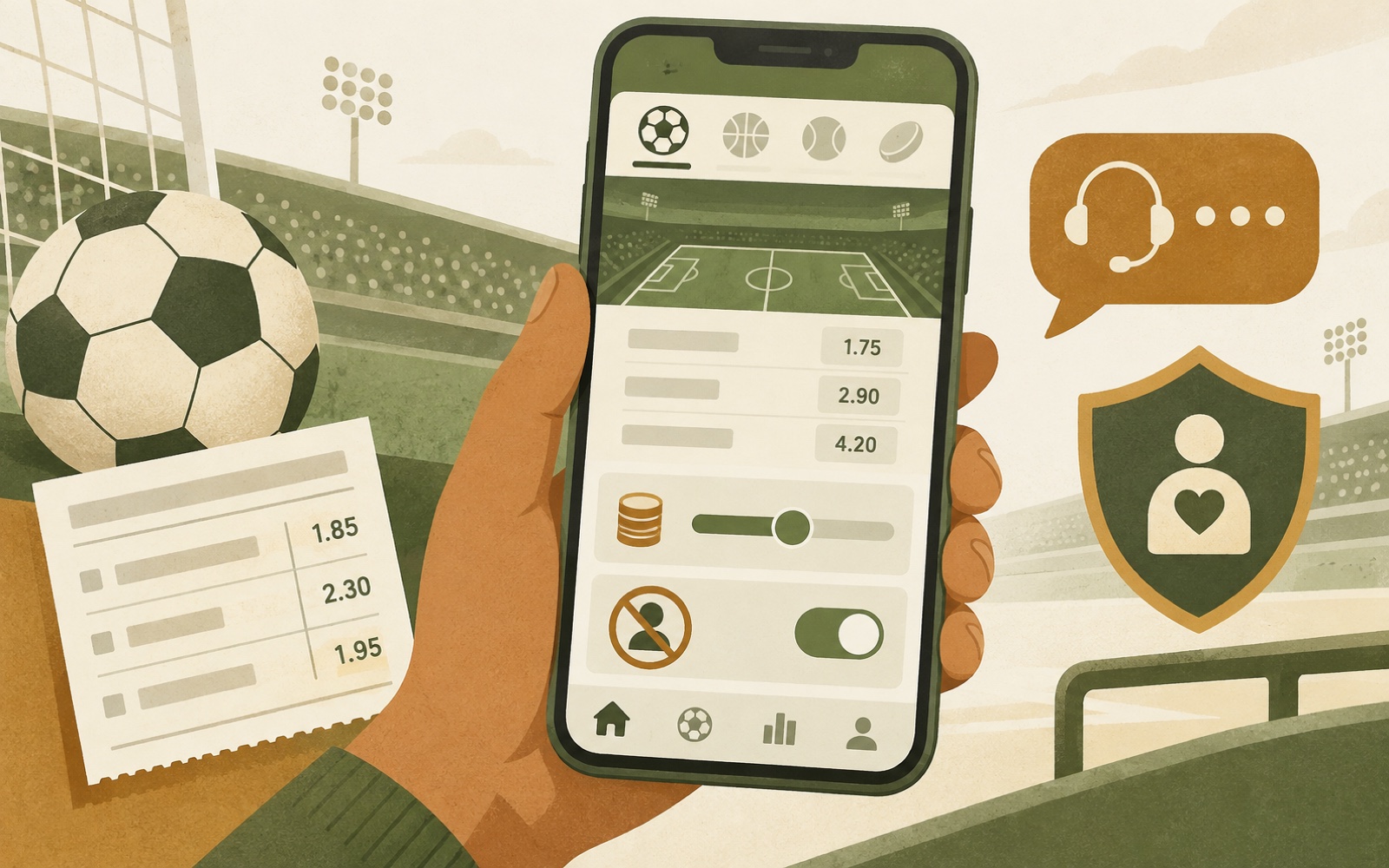
Most betting now happens on a phone, either through a dedicated app or through a mobile browser. The two feel different, yet behind both sits the same licensed operator bound by the same rules. Judging an app is therefore less about the interface and more about whether the company behind it is properly licensed, offers the controls it must, and gives you a clear route when something goes wrong.
This guide keeps that regulatory focus. We look at what a good app should let you do, how to stay secure, what support you are entitled to expect, and how the formal complaints process works when a bet or a withdrawal is not handled as it should be. Knowing the route in advance is far easier than learning it in the middle of a dispute.
01
Betting apps compared with the mobile site
An app is software you install, while a mobile site runs in your browser with nothing to download. Each has its merits. An app can be faster once installed, can send notifications, and can add a passcode or fingerprint lock at the device level. A mobile site needs no storage, updates itself, and lets you check an operator without committing to an install.
What does not change between them is the operator's obligations. The same UK Gambling Commission licence covers both, so the same rules on fair terms, age verification, and safer gambling apply whether you tap an icon or type a web address. If a feature such as deposit limits exists on the site but not in the app, that inconsistency is a fault worth noting rather than a quirk to accept.
02
The in-app controls a licence requires
A licensed operator does not provide safer gambling tools as a favour; the Licence Conditions and Codes of Practice require them, and they must be usable wherever you play. In an app that means you should be able to set deposit limits, take a time-out, and request self-exclusion from within your account, not only by contacting support. Reality-check reminders should appear during longer sessions so that time does not slip away unnoticed.
Every licensed app must also point you to GAMSTOP, the free national self-exclusion scheme that blocks all GB-licensed online gambling with a single registration. The presence, prominence and ease of these controls tell you a great deal about how an operator sees its customers.
A common example
Before you deposit anything, open the app's account or safer gambling menu and set a deposit limit you are comfortable with. A well-built app applies it immediately and makes any later increase take effect only after a cooling-off period, as the rules intend. If you cannot find these settings in a couple of taps, that difficulty is itself a reason for caution.
| Control | What it does | Where to find it |
|---|---|---|
| Deposit limit | Caps what you can add per day, week or month | Account or safer gambling menu |
| Time-out | Short break, typically 24 hours to 6 weeks | Safer gambling settings |
| Reality check | On-screen reminders of time and spend | Safer gambling settings |
| Self-exclusion | Blocks the account for six months or more | Safer gambling, plus GAMSTOP |
03
Security, logins and staying safe on mobile
Because a betting app holds your identity and a payment method, treat its security as you would a banking app. Only install from the official Apple App Store or Google Play, or from a link on the operator's verified website, and check the developer name matches the brand. Turn on a device passcode or biometric lock, use a strong and unique password, and enable two-factor authentication if it is offered.
Be alert to messages that try to rush you into logging in through a link. A licensed operator will not ask for your password by email or text, and it should never pressure you to lift your own safer gambling limits. If a site or message urges you towards an operator that describes itself as an alternative to GAMSTOP, it is by definition outside the licensed system, and our warning signs guide explains why that is a firm reason to stop.
04
Customer support and the standards to expect
Good support is easy to reach and gives clear, timely answers. Look for more than one contact channel, typically live chat and email, with a published response time, and a searchable help section that sets out the operator's rules. The Commission's codes require terms to be transparent and communications to be fair and not misleading, so support that dodges a direct question or hides its own rules falls short of what a licence expects.
When you contact support about anything that could become a dispute, put it in writing and keep the record. Ask for a reference number, note the date and time, and save the reply. That habit costs nothing and turns a vague disagreement into a documented one, which matters if the matter has to be escalated.
Key points
- Apps and mobile sites are covered by the same licence, so the licence, not the format, is what protects you; verify it on the public register.
- Deposit limits, time-outs, reality checks and self-exclusion must be available in the app, alongside a link to GAMSTOP.
- Complain to the operator first; after eight weeks or a deadlock you can go free of charge to an approved ADR provider such as IBAS.
05
How to make a complaint that gets heard
The route is fixed and it starts with the operator. Every licensed betting company must have a complaints procedure and must tell you how to use it. Put your complaint in writing, describe what happened and what you want done, and attach your evidence, the betslip, the terms shown at the time, screenshots and any support messages. Ask for a final written response.
Give the operator a reasonable chance to resolve it, but do not let it drift. If eight weeks pass without a resolution, or the operator issues a deadlock letter saying it can do no more, you have the right to take the matter further at no cost. A complaint that is documented from the first message is far harder to brush aside than one raised only by phone.
A common example
A withdrawal is delayed while the operator asks for identity documents you were never prompted for at sign-up. You send the documents, confirm receipt in writing, and set a clear deadline. If the money still does not arrive and the operator will not explain the hold, you request a deadlock letter and prepare to escalate to its dispute-resolution provider with your dated record in hand.
06
Alternative dispute resolution and IBAS
Alternative dispute resolution, or ADR, is a free, independent service that reviews unresolved complaints between customers and operators. Every licensed operator must sign up to a Commission-approved ADR provider and must take part when a customer refers a case. One of the best known in betting is the Independent Betting Adjudication Service, or IBAS, which examines the evidence from both sides and issues a decision the operator is expected to honour.
You do not choose the provider freely; you use the approved ADR body that the operator is signed up to, which its terms and its help pages must state. ADR looks at whether the operator applied its own terms and the rules correctly, so the paper trail you built at the complaint stage is exactly what the adjudicator needs. It is a route to a fair review, not a guarantee of the answer you want.
07
When and how the regulator gets involved
It is worth being clear about what the Gambling Commission does and does not do. It licenses operators, sets and enforces the conditions they must meet, and can fine, restrict or revoke a licence when a company falls short. It does not act as a small-claims service, so it will not settle your individual bet dispute or order a refund. What it will do is use the complaints and information it receives to spot patterns of poor practice and act on them.
That is why reporting a problem still matters even when your own remedy lies with ADR. Change is also coming to this area. The government's 2023 White Paper, High stakes, gambling reform for the digital age, proposed a Gambling Ombudsman to give consumers a single, statutory-backed body for disputes. Until it is fully in place, the operator-then-ADR route remains the one to follow, and free confidential help with gambling itself is always available from GamCare.
Related reading on this site
- How to choose a betting site in the UK
- How to check a betting site's UKGC licence
- Understanding odds, markets and value
- Deposits, withdrawals and the credit-card ban
- Safer gambling tools and GAMSTOP
- Warning signs of an unsafe betting site
- Bet types, accumulators and cash out
How we check our facts
We rely on primary UK sources. The complaints and ADR framework is taken from guidance published by the Gambling Commission, the Gambling Ombudsman proposal from the government's 2023 White Paper on gov.uk, and safer gambling information from GamCare. This page was last reviewed on 25 September 2026.

Frequently asked questions
Is a betting app safer than using the mobile website?
Neither is inherently safer, because both are run by the same licensed operator under the same rules. An app can add device-level protection such as a passcode or biometric lock, while a mobile site needs no download and cannot be missed in an app store review. What matters more than the format is that the operator appears on the UKGC public register and offers the same safer gambling tools in both places.
What safer gambling controls must a betting app offer?
A licensed app must let you set deposit limits, take a time-out, and self-exclude, and it must show reality-check reminders during play. It must also link to GAMSTOP, the free national self-exclusion scheme that blocks every GB-licensed online operator at once. These are licence requirements, not optional extras, and a control that is hidden or hard to use is a warning sign.
How do I complain about a betting operator, and how long does it take?
Complain to the operator first, in writing, and keep a copy. If it is not resolved, or after eight weeks without agreement, you can take the complaint free of charge to the operator's approved alternative dispute resolution provider, such as IBAS. The ADR provider reviews the evidence from both sides and reaches a decision, and a licensed operator must take part in that process.
Will the Gambling Commission settle my dispute for me?
No. The Gambling Commission does not settle individual disputes or recover money for customers. It does use the complaints and information it receives to spot patterns, hold operators to their licence conditions and take enforcement action. Your route to a personal remedy is the operator's complaints process and then an approved ADR provider, with a Gambling Ombudsman proposed under the 2023 White Paper to strengthen that route.