
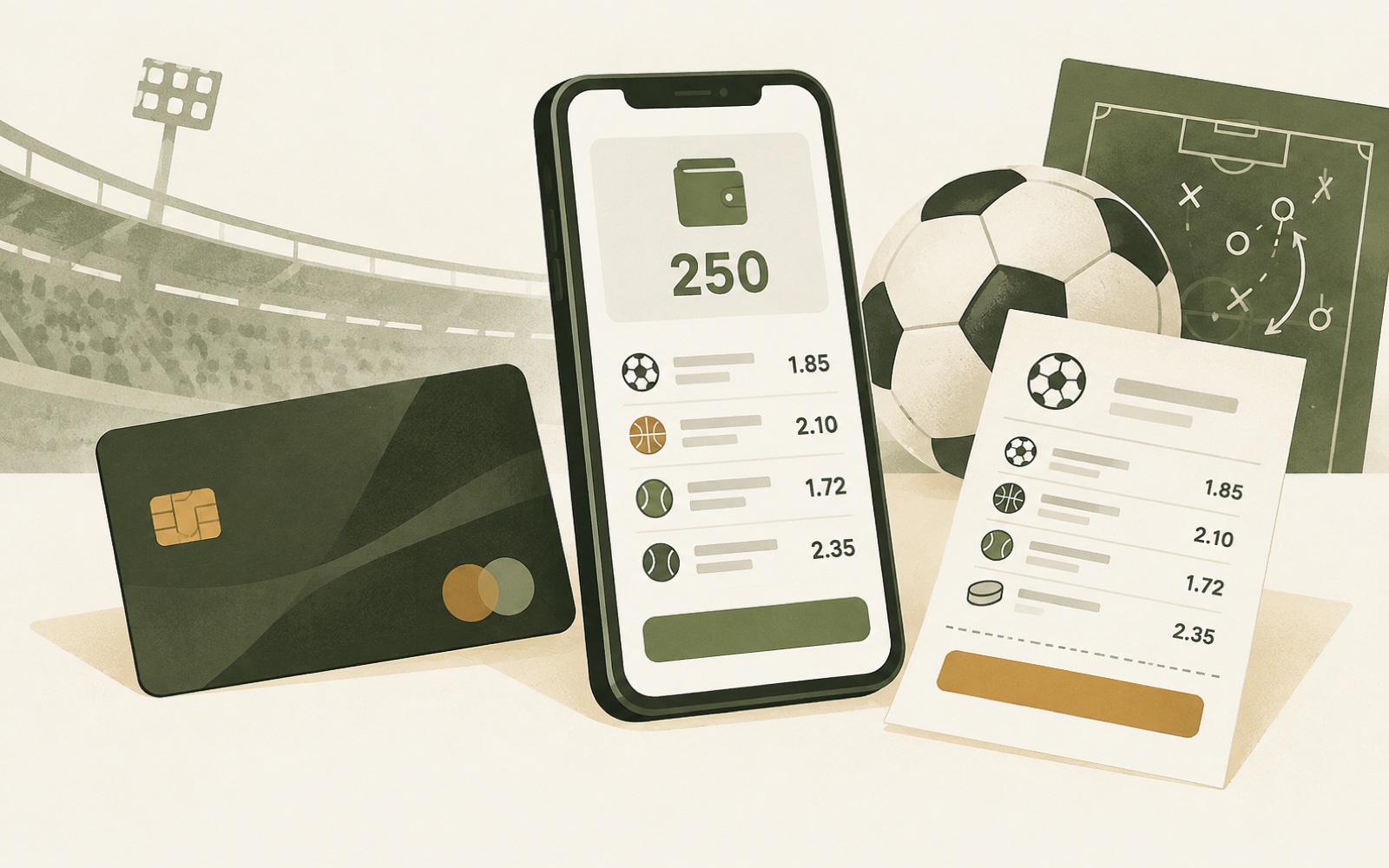
Payments are where a betting site's real attitude to its customers shows most clearly. The deposit page tends to be smooth and quick, because the operator wants your money in. The withdrawal page, and how the site behaves when you use it, is the truer test. Read both before you fund an account, not after.
Everything here assumes you are dealing with a licensed operator. The payment rules below, from the credit-card ban to identity verification, are licence conditions, so a site that ignores them is telling you it is not playing by the Commission's book.
01
Debit cards and the credit-card ban
Since April 2020 a licence condition has banned the use of credit cards for gambling with GB-licensed operators. The reasoning is straightforward. Betting with borrowed money makes losses harder to see and easier to spiral, so the Commission removed credit from the equation. The ban covers online betting and most non-remote gambling too.
What remains permitted is any funding that does not ultimately draw on credit. Debit cards are the mainstay, alongside bank transfer, open banking and e-wallets fed from a debit source. If a site offers to take a credit card for a bet, it is not following its licence, and that alone is reason enough to leave.
02
E-wallets, bank transfer and open banking
E-wallets add a useful layer between your bank and the betting site, so the operator never sees your card details directly, but they must be funded from a debit source to stay within the credit-card ban. Bank transfer is slower but simple, and open banking, which moves money directly from your account with your authorisation, has grown quickly because it is fast and carries strong security.
Whichever method you choose, the same principle applies. The money should be yours, not borrowed, and you should be able to withdraw back to the same method you deposited with wherever possible.
A worked example
You fund an e-wallet from your debit card, then deposit to a betting site from the wallet. That is fine. If instead you were to load the wallet from a credit card and then gamble, you would be defeating the purpose of the ban, which is exactly the loophole the rules are written to close.
03
Verification, identity checks and why they protect you
Licensed sites must verify your identity and age, and sometimes your source of funds, under both gambling and anti-money-laundering rules. Done properly, this happens when you register, before you deposit or play. It protects you as much as the operator, confirming that no one else can open an account in your name and that winnings can be paid to the right person.
The table below sets out where payment terms sit alongside the other first checks on any site.
| What to check | Why it matters | Where |
|---|---|---|
| UKGC licence | Legal to serve UK, dispute route | Public register |
| Safer-gambling tools | Limits, time-outs, self-exclusion | Account settings |
| Payment terms | Debit only, clear withdrawal times | Banking page |
04
Withdrawal times and the delays to watch
Once your identity is verified, a debit-card or e-wallet withdrawal is commonly processed within one to three working days, while bank transfers can take a little longer. A trustworthy operator states these times plainly on its banking page. What should concern you is delay without explanation, or fresh conditions that appear only when you ask for your money.
The classic red flag is a site that let you deposit instantly but suddenly needs documents, cooling-off periods or manual reviews the moment you win. Verification belongs at the start, not the finish.
Key points
- Credit cards have been banned for gambling since April 2020; lawful deposits come from debit cards, bank transfer, open banking or debit-funded e-wallets.
- Identity checks are a licence requirement and should happen at registration, not be sprung on you at withdrawal.
- A pattern of delayed or blocked withdrawals is a warning sign, covered further in our warning signs guide.
05
Financial risk checks explained
Financial risk checks are often misunderstood, so it helps to be precise. They are being phased in as frictionless checks against public data, such as bankruptcy orders, county court judgments and IVAs, rather than a demand for your bank statements. A light background check can apply once net deposits pass £150 in a rolling month, the threshold set from 28 February 2025, after an initial £500 stage from 30 August 2024.
The intention is to catch clear signs of financial distress quietly, without disrupting the vast majority of customers. A licensed operator should be able to explain how it applies these checks if you ask.
A worked example
If your net deposits across a month stay modest, you may never notice a check at all. Cross the threshold and a background check may run automatically in seconds, drawing only on public records. It is meant to be invisible in normal use, not a request for paperwork every time you play.
06
Fees, limits and currency to look out for
Read the banking page for the small print that costs money. Look for withdrawal fees, minimum and maximum withdrawal amounts, and any charge for using a particular method. Deposits should be in pounds sterling for a UK customer, and any currency conversion is a sign you may not be dealing with a site set up for the British market.
Note too whether the site imposes its own deposit limits and whether you can set your own. A licensed operator must let you set a deposit limit, and doing so from the outset keeps your spending where you want it.
07
Keeping a clear record of what you spend
A simple record of deposits and withdrawals is one of the most useful safer gambling habits there is. Because credit cards are out of the picture, your debit statement gives you an honest running total, and many licensed sites also show your net position in your account history. Reviewing it regularly stops small, frequent deposits from adding up unnoticed.
If the numbers ever feel uncomfortable, the tools are already in your hands. Set a deposit limit, take a time-out, or register with GAMSTOP, all of which we cover in the safer gambling guide.
Related reading on this site
- A step-by-step way to choose a betting site
- Verifying a licence on the UKGC register
- Reading odds, margins and real value
- Safer gambling controls and GAMSTOP
- Spotting a betting site to avoid
How we check our facts
The payment rules here, including the credit-card ban of April 2020 and the financial risk check thresholds phased in during 2024 and 2025, follow the Licence Conditions and Codes of Practice published by the Gambling Commission under the Gambling Act 2005. This guide was last reviewed on 25 September 2026.

Frequently asked questions
Why can't I use a credit card to deposit at a betting site?
A licence condition introduced in April 2020 bans credit cards for gambling with GB-licensed operators, so that people cannot bet with borrowed money. It applies to online and most non-remote gambling. You can still deposit with a debit card, bank transfer, open banking or an e-wallet funded from a debit source, provided the money is not ultimately drawn from credit.
Why is a betting site asking me for identity documents?
Verifying your identity, age and sometimes source of funds is a licence requirement, not an obstacle the site invents. A well-run operator completes these checks when you register, before you play. If a site only asks for documents once you try to withdraw a win, that late timing is itself a warning sign worth taking seriously.
How long should a withdrawal from a betting site take?
Once your identity is verified, a debit-card or e-wallet withdrawal is commonly processed within one to three working days, though bank transfers can take longer. Times vary by operator and method, so check the banking page before you deposit. Repeated, unexplained delays, or new conditions appearing only at withdrawal, are patterns to avoid.
Will a betting site check my finances, and what does that involve?
Frictionless financial risk checks are being phased in, running quietly against public data such as bankruptcy orders, county court judgments and IVAs. A light background check can apply once net deposits pass £150 in a rolling month, the threshold set from 28 February 2025 after an initial £500 stage from 30 August 2024. They are designed not to require your bank statements.