
Account restrictions
Why Bookmakers Close Accounts and Limit Stakes
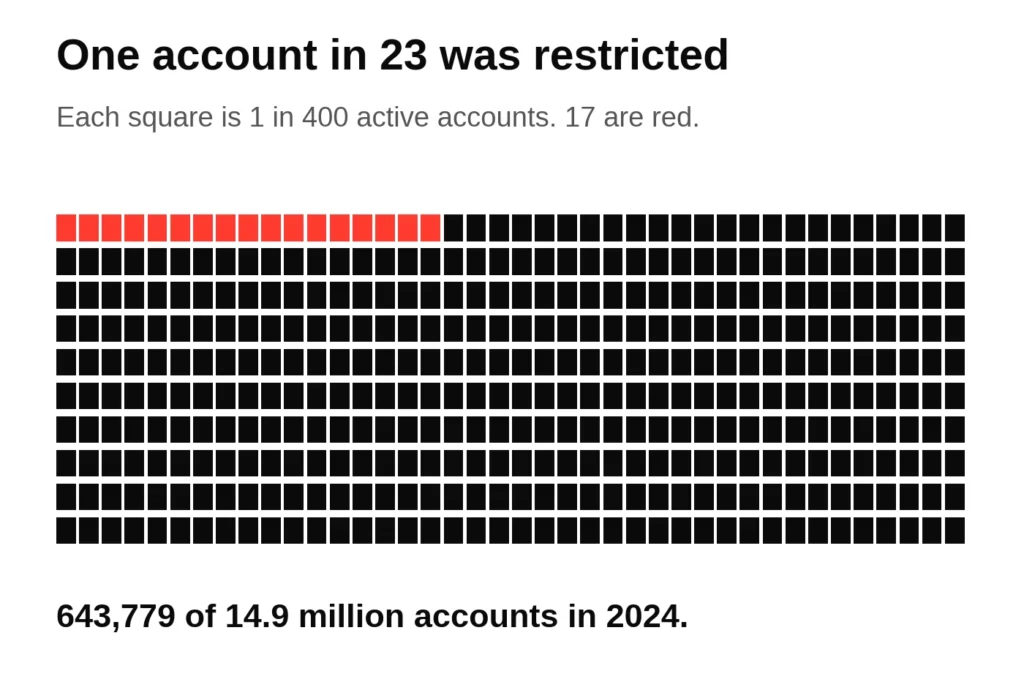
Why bookmakers close accounts and cut stakes now has a measured answer: in 2024 they restricted 643,779 British accounts, and the customers they restricted were almost twice as likely to be in profit as the average. The regulator published the numbers for the first time in July 2025, and this page sets out what it found, what a restriction actually does to your account, and what is left to do about it.
 By
By

How many accounts get restricted
Until July 2025 nobody outside the industry knew the scale of this. The Gambling Commission asked the largest online betting operators for data on every commercial restriction applied during the 2024 calendar year, covering almost fifteen million customer accounts, and published the result.
Out of 14,923,840 active accounts, 643,779 carried a restriction. That is 4.31 per cent, or one account in every twenty-three.
What a restriction actually is
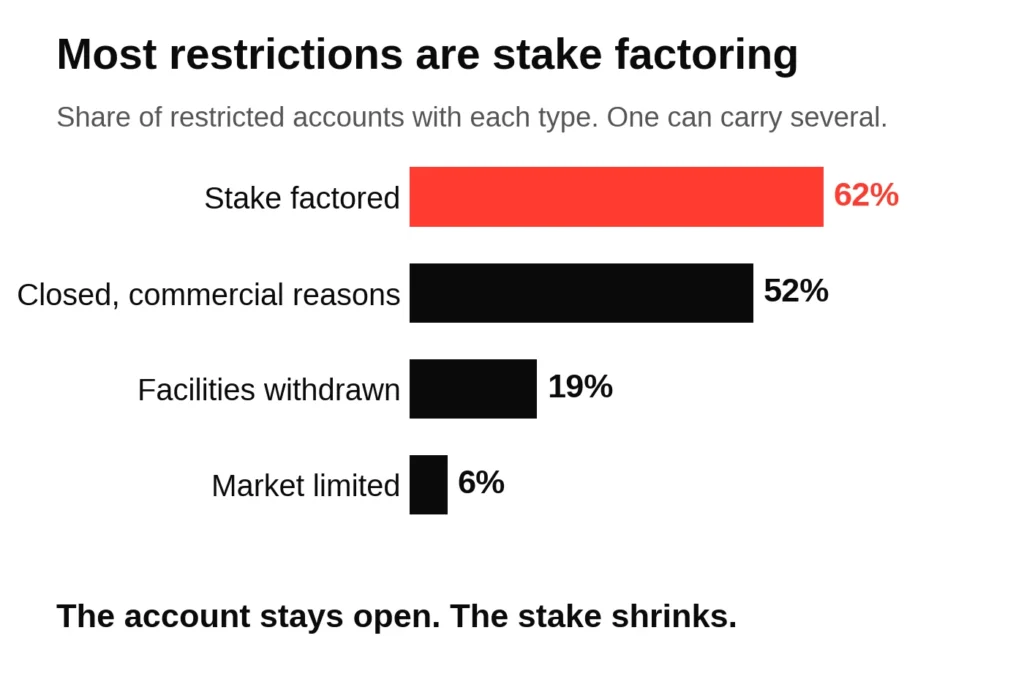
The word restriction covers four different things, and they are not equally likely. The commonest by a distance is stake factoring, which leaves the account open and the markets visible and simply cuts the number you are allowed to type into the stake box.
The shares below add up to more than a hundred per cent because a single account can carry several restrictions at once, which is itself worth knowing. Being stake factored and then closed is a common sequence rather than two alternatives.
The four forms, and what each one does to you
| Stake factoring | A multiplier applied to your maximum bet. 62.17 per cent of restricted accounts. The account looks completely normal until you try to place a bet of any size. |
|---|---|
| Commercial closure | The account is shut. 51.69 per cent of restricted accounts, and usually the end of a road that started with factoring. |
| Betting facilities withdrawn | The account stays open but you cannot bet. The regulator notes this is sometimes done by setting the stake factor to zero. 19.15 per cent of restricted accounts. |
| Market limited | Restricted on one sport or market type while the rest of the account behaves normally. 5.72 per cent, and the hardest to notice. |
How deep a stake factor goes
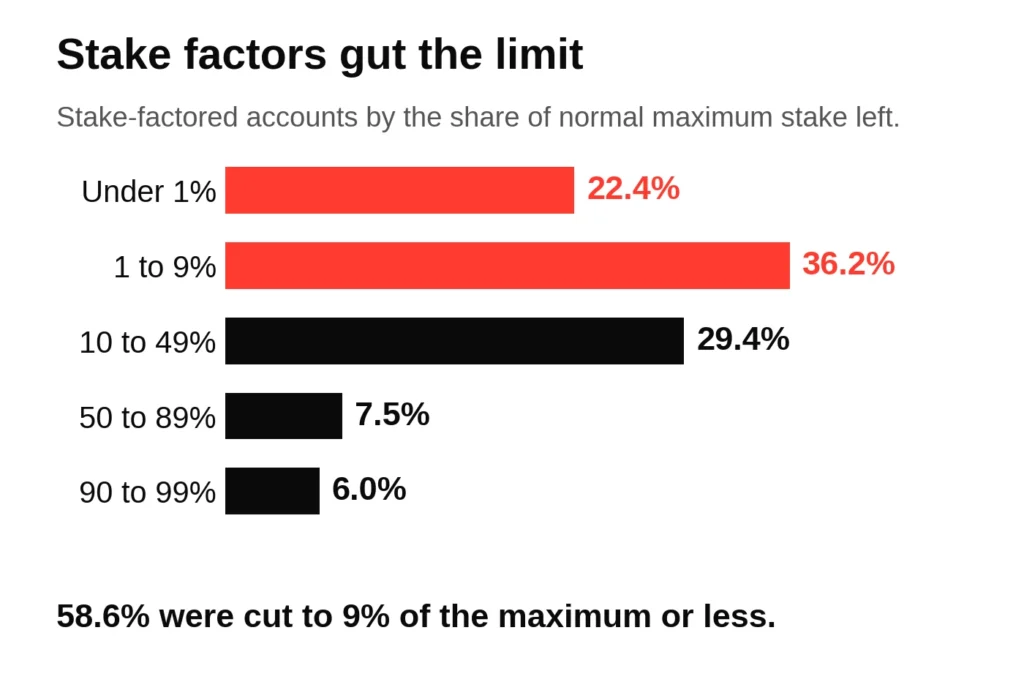
This is the number that changes how the practice reads. A stake factor could in principle be a light touch, trimming a heavy hitter from a thousand pounds to nine hundred. In practice it is not.
The regulator broke the factored accounts down by how much of the normal maximum stake they were left with. More than a fifth were left with under one per cent of it. Add the next band and 58.63 per cent of stake-factored accounts were cut to nine per cent of the normal maximum or less, which on a book that lays 500 pounds to an unrestricted customer means being left with 45 pounds or less.
Who gets restricted
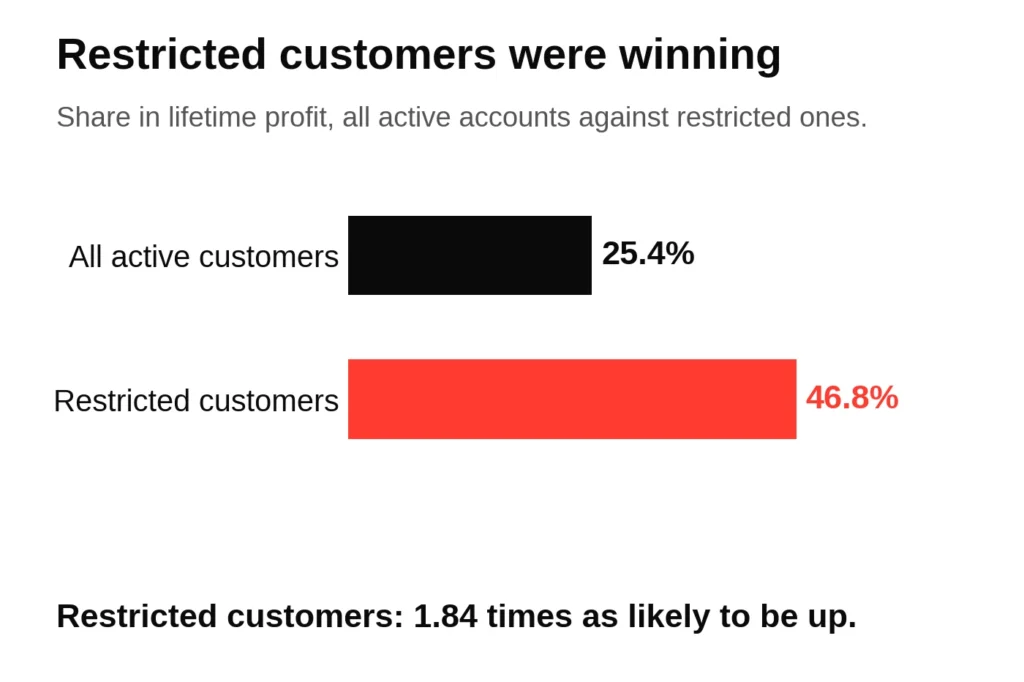
The regulator asked one more question, and the answer is the reason the practice exists. Among all active customers, 25.42 per cent were in lifetime profit. Among restricted customers, 46.78 per cent were.
A restricted customer is 1.84 times as likely to be in profit as the average one. Restriction is not a fraud control or a safety measure. It is a commercial response to customers who were winning, applied by businesses that are entitled to choose who they trade with.
What actually triggers it
No bookmaker publishes its criteria, and the behaviours below are inferred from what restricted punters consistently report rather than from any operator statement.
-
Beating the closing price
Taking 5.00 about a horse that starts at 4.00, repeatedly. It is the cleanest signal that you knew something the market had not priced yet, and it does not require you to have won the bet.
-
Betting early into fresh markets
New markets are the least accurate. A customer who consistently appears in the first hour is telling the trader where the price is wrong.
-
Taking the best price every time
Which is exactly what an odds comparison site is for, and exactly what a bet return calculator encourages once you can see what the difference is worth.
-
Arbitrage and value hunting
Backing both sides across two books for a guaranteed margin is the fastest route to a factored account, and it is usually detected within days rather than months.
-
Simply being in profit
The regulator data makes this one explicit. Nothing clever is required. A customer who is up over time is more likely to be restricted than one who is not.
How you find out
There is no notification, no email and no entry in your account history. The markets look the same, the prices look the same, and the only symptom is that a stake you could place last week is refused this week, often with a message offering to accept a smaller amount.
Because the account still works, most people assume they have hit a market-specific limit rather than a personal one. The way to test it is to price the same selection at a stake you know used to be accepted, and compare what you are now offered against what a new account is offered on the same market.
Why there is no appeal
This is the part that has no good answer. The Gambling Commission has been consistent that decisions about who an operator will trade with, and for how much, are commercial matters that sit outside its remit. It publishes data on the practice, as it did here, but it does not adjudicate individual cases.
The alternative dispute resolution services that handle betting complaints deal with disputes about particular transactions, a settled bet or a withheld payout. A bookmaker deciding it would rather lay you 20 pounds than 500 is not a transaction dispute, so there is nothing to adjudicate. The practical position is that a restricted British punter has no route of appeal anywhere.
What you can do about it
You cannot argue your way out of a restriction, so everything useful is about not depending on one account in the first place. Holding accounts at more than one book is the first step, and our bookmaker ranking scores every book on how it treats a winner.
Five responses that actually work
None of these will stop a book restricting you. They change what happens to you when it does.
-
Hold several accounts from the start
Open them while you are an ordinary customer rather than after you have been factored. The capacity you need later is easiest to build before anyone is watching.
-
Know what the price difference is worth
Shopping around is what gets you restricted and it is also the single largest saving available to you. The arithmetic is on our page about the margin built into a price.
-
Use an exchange for size
An exchange charges commission on winnings rather than building a margin into the price, and it has no reason to restrict a winning customer because it is not taking the other side of your bet.
-
Take price concessions where they exist
Best odds guaranteed pays you the better of your price and the starting price, and it is a genuine edge while you still have an account that can use it. Which books apply it, and to what, is on our best odds guaranteed page.
-
Get your money out cleanly
A restricted account is often a prelude to a closed one, and a closed account with a balance and unverified documents is a slow problem. Payout behaviour by method is covered on our fast withdrawal page.
The offshore alternative is worth stating plainly rather than hinting at, because it is the reason this page exists on a site like ours. Books licensed outside Great Britain are not operating under the same commercial model and do not factor stakes in the same way or at the same speed. The trade is real in both directions, and a reader who has just been cut to 45 pounds a bet at a licensed book is entitled to know the option exists.
The same measurement discipline applies wherever you bet. We price markets rather than count features, and the method is set out on our football betting page, where the sample comes from.
Account restriction questions answered
Yes, and they are entitled to. A bookmaker chooses who it trades with and for how much, the same as any other business. The regulator collected the data and published it in July 2025 but has been consistent that the decision itself sits outside its remit.
Because the customers being restricted were winning. Among all active accounts 25.42 per cent were in lifetime profit; among restricted accounts 46.78 per cent were. It is a commercial response to a losing trade rather than a safety or fraud measure.
A multiplier has been applied to your maximum bet, so a book that would lay an unrestricted customer 500 pounds might lay you 5. The account otherwise looks completely normal, which is why most people find out by being refused a stake rather than by being told.
You will not be told. There is no email and nothing in your account history. The symptom is a stake that used to be accepted being refused, usually with an offer of a smaller amount. Test it by trying a stake you know used to go on.
In practice, no. The regulator treats how much an operator will lay you as a commercial decision outside its remit, and the dispute services handle arguments about specific transactions rather than commercial ones. There is no route that reverses a stake factor.
British betting slang for having an account restricted or closed, usually after winning. It is not an industry term and appears in no bookmaker terms, but it is what the subject is called on forums and in matched betting circles.
Consistently taking the best available price is one of the behaviours restricted punters report most often, because it is visible to a trader as a pattern. It is also the largest saving available to you, which is the bind at the centre of this whole subject.
The practice is near universal among the large British-licensed operators covered by the data request, though the thresholds and the speed differ a great deal between them. Books licensed outside Great Britain work to a different commercial model and do not factor in the same way.