 By
By
Top Choice
1

Gamble Gorilla
- Exclusive Free Bet Offer
- In-Play Live Betting
- Broad Sports Coverage
Bonus
WELCOME SPORTS FREEBET
UP TO £100
FREEBET
UP TO £100
FREEBET

New betting sites
New betting sites are easy to find and hard to judge, because what makes one worth joining is not on its homepage: who holds the licence, what its prices cost you and how it treats a winning account. This page shows how to check all three in a few minutes, what a new UK-licensed book has to ask of you from day one, and where the offshore books in our ranking do things differently.














A new book has no track record, so we judge it on things you can check on the day you find it rather than on reputation.
A new book can be excellent. It can also be an old book with a new logo. The checks on this page separate the two.
New covers four different things, and they are worth telling apart, because only one of them is a genuinely new bookmaker.
| A new operator | A company that has built or bought its own platform and holds its own licence. The rarest kind, and the only one with no history anywhere |
|---|---|
| A new brand on an existing licence | A white label. The brand and the website are new; the licence belongs to a company that already runs other sites |
| A rebrand | An existing book under a new name, often after a change of owner. The business behind it is not new, only the name |
| New to UK punters | A book that has taken bets elsewhere for years and has only recently opened to customers in Britain. New here, not new to bookmaking |
For a punter the second kind matters most. A white label is a real brand with a real website, but if its licence sits with a company running several other sites, joining it can be closer to opening a second account at a book you already know than to trying something new.
Every licensed book names the company that holds its licence, usually in the footer, with a licence number and the regulator that issued it. That company, not the brand on the homepage, is who you are dealing with, and the regulator’s own register tells you who it is and what else it runs.
Do this before you deposit, not after a withdrawal is held.
Scroll to the bottom of the site and note the company name, the licence number and the regulator. A licensed book states all three; a site that states none of them is not worth a second look.
For a UK licence, the Gambling Commission’s public register can be searched by business name, trading name, domain name or account number. For a Curacao licence, the Curacao Gaming Authority publishes its own licence register.
A UK licensee’s register entry lists the websites it trades under and marks each one Active, Inactive or White label. A long list of domains under one company tells you the new brand is one of many.
The company on the register should be the one in the footer and in the terms. A mismatch is the one result that should stop you.
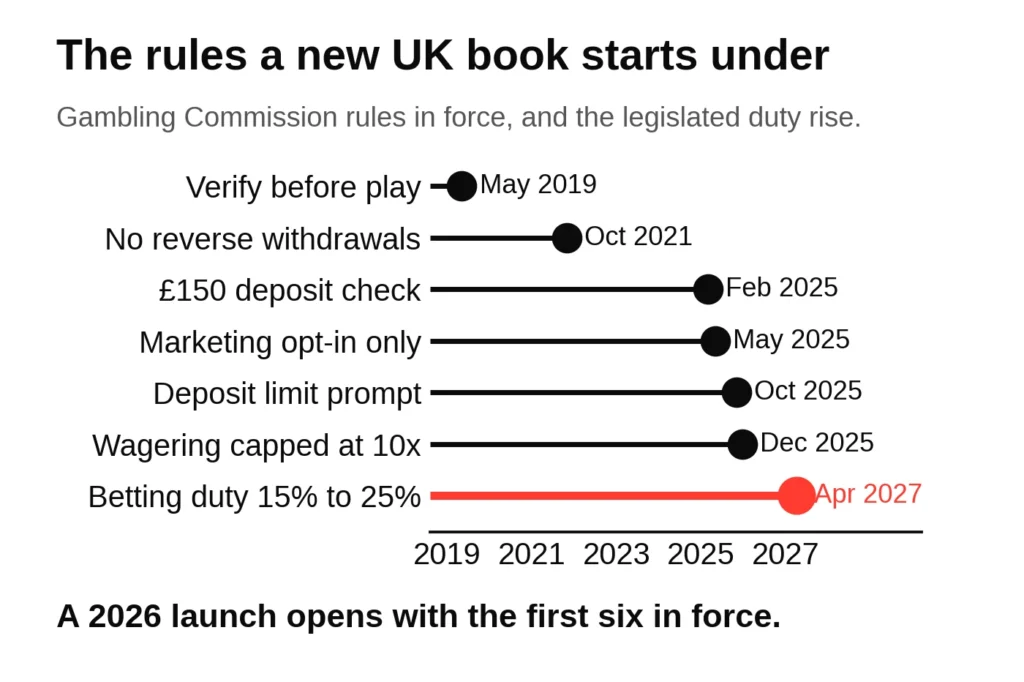
A book that gets a Gambling Commission licence this year does not launch into the market of ten years ago. It starts with every rule that has built up since, and several of them shape your first week with it.
None of this is optional for a UK licensee, however new it is.
A book licensed outside Great Britain, in Curacao or Anjouan for example, works under its own regulator’s rules rather than the Gambling Commission’s. For a punter the differences show up in the first hour.
| Before betting | UK: identity verified first. Offshore: often a deposit and a bet within minutes, with documents asked for later, usually at the first withdrawal |
|---|---|
| First deposit | UK: a deposit limit prompt, with a limit pre-selected. Offshore: no mandatory prompt; you pay in and bet |
| Deposit checks | UK: a vulnerability check once net deposits pass 150 pounds in 30 days. Offshore: not required by UK rules |
| Welcome offers | UK: wagering capped at 10 times, no mixed betting and casino offers. Offshore: set by the book, so offers can be larger and terms vary more |
| Payment rails | UK: cards, bank transfer and e-wallets. Offshore: crypto alongside cards and e-wallets at many books |
| On your phone | UK: apps in the App Store and Google Play. Offshore: a mobile site or a web app saved to your home screen |
The trade is speed and freedom for the paperwork a UK book does up front.
Most new books can be price-checked before you give them a penny, because the odds are visible without an account. One Premier League match is enough to start. Established books are scored on the same prices in our betting sites list, so a newcomer has a benchmark.
Use decimal odds, and switch the site’s odds format if it opens in fractions.
Choose a Premier League game this weekend and open the match result market: home, draw and away.
Divide 100 by each decimal price. At 2.10, 3.40 and 3.60 that gives 47.6, 29.4 and 27.8 per cent.
Anything above 100 is the book’s margin on that market. The example totals 104.8, a margin of 4.8 per cent.
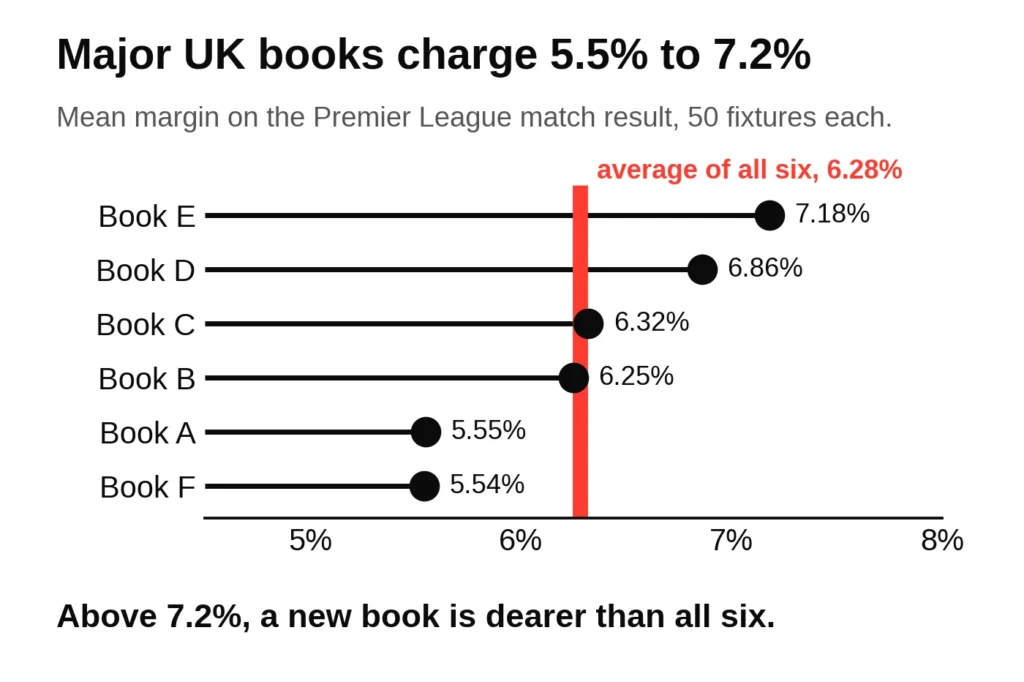
Across 50 Premier League fixtures the six major UK books we measured averaged 6.28 per cent on this market. The keenest averaged 5.54 and the dearest 7.18.
One market can be priced keenly to draw people in, so repeat the check on two other fixtures before you judge the book.
| Under 5.5 per cent | Keener than the average of all six major UK books we measured |
|---|---|
| 5.5 to 6.3 per cent | Inside the range of the major books, at or better than their combined average of 6.28 |
| 6.3 to 7.2 per cent | Dearer than average, but no dearer than the dearest major book |
| Over 7.2 per cent | Dearer than the average of every major book we measured on this market |
The benchmark comes from 300 book-and-fixture prices on Premier League match results between 21 August and 20 September 2026. The arithmetic behind the check, and why the margin matters more than any single price, is set out on our page about the overround.
A new book limits accounts like any other. Being new does not change the economics: a book that keeps taking a winning punter’s bets loses money on them, whatever its age.
A new book needs customers, and the welcome offer is how it asks for them. At a UK book that offer now sits inside tighter rules than it did a few years ago.
We value offers in cash rather than by the headline, and the working is on our page of betting sign up offers.
Paying in at a new book is quick almost everywhere. The first withdrawal is where a new book shows what it is.
How long each method takes to reach you once a book has approved a payout is covered on our fast withdrawal page.

Most of the checks above end in a judgement call. A few settle the question on their own.

The best reason to open a new account is not the welcome offer. It is another price. Every book you hold is one more quote on the same match, and on our Premier League sample, betting every outcome at one average book carried a margin of 6.13 per cent, while taking the best price across six books on each outcome cut it to 0.95 per cent. The full dataset is on our football betting sites page.
From 1 April 2027 the duty a UK-licensed book pays on remote betting rises from 15 to 25 per cent of its gross profit, with bets on UK horseracing kept at the old rate. Remote gaming duty already rose from 21 to 40 per cent in April 2026.
Whether fewer UK books launch after the rise is not something anyone can measure yet. The arithmetic is the part that is already certain.
The books in our ranking above are shown with their current offers, and the list updates as books join or drop out. A new name is not always a new company, so check the licence holder on the regulator’s register before assuming a book is new.
A licensed one is as accountable as its licence holder. Check the licence number against the regulator’s register and read the settlement and withdrawal terms before you deposit. The age of the site is not the test; who holds the licence and what the terms say are.
Not automatically. Some are keen and some are not, and a new logo says nothing either way. Check one match result market: the six major UK books we measured averaged a 6.28 per cent margin on Premier League match results.
A brand that runs under another company’s gambling licence. It has its own name and website, but the licence holder answers to the regulator for it. The Gambling Commission register marks such domains as white label.
A UK-licensed site must verify your identity before you can place a bet. A book licensed elsewhere is not bound by that rule and often lets you deposit and bet first, but expect to send documents at your first withdrawal.
They can be, because a new book needs customers. UK offers are capped at 10 times wagering and cannot mix betting with casino play; offshore offers are set by the book. Value any offer in cash, not by its headline.
It can, and at any time. Being new does not change the economics of taking a winning punter’s bets. Check the maximum stake on an ordinary market early, and hold more than one account so a limit at one book does not stop you betting.
Find the company name and licence number in the site’s footer, then search the regulator’s register. The Gambling Commission register can be searched by business name, trading name, domain name or account number, and lists the websites each licensee trades under.