 By
By
Top Choice
1

Gamble Gorilla
- Exclusive Free Bet Offer
- In-Play Live Betting
- Broad Sports Coverage
Bonus
WELCOME SPORTS FREEBET
UP TO £100
FREEBET
UP TO £100
FREEBET

Golf
Golf betting is where the widest outright margins in sport sit, so the book you use matters more here than almost anywhere. We measured two full outright markets across every book that priced them, and ranked on price, each way terms and how the book treats a winning account.














A golf outright prices more than a hundred players, and books differ on almost every one of them. We start with the price of the whole market, then the terms that decide what an each way bet pays, then the things that decide whether you can keep betting at that book. Those tests are shared by every betting site we rank, whatever the sport.
We read every price in two outright winner markets on 28 September 2026, the Alfred Dunhill Links on the DP World Tour with 165 players and the Bank of Utah Championship on the PGA Tour with 116, at every book that priced the full field. Add up the chance each price implies and a fair market totals 100 per cent.
No single book came close. The each way books ran between 153.9 and 170.7 per cent, a margin of more than half the market, and even the one win-only book was at 149 to 151 per cent. That is nine times the margin on a football match result and well above a 16-runner handicap.
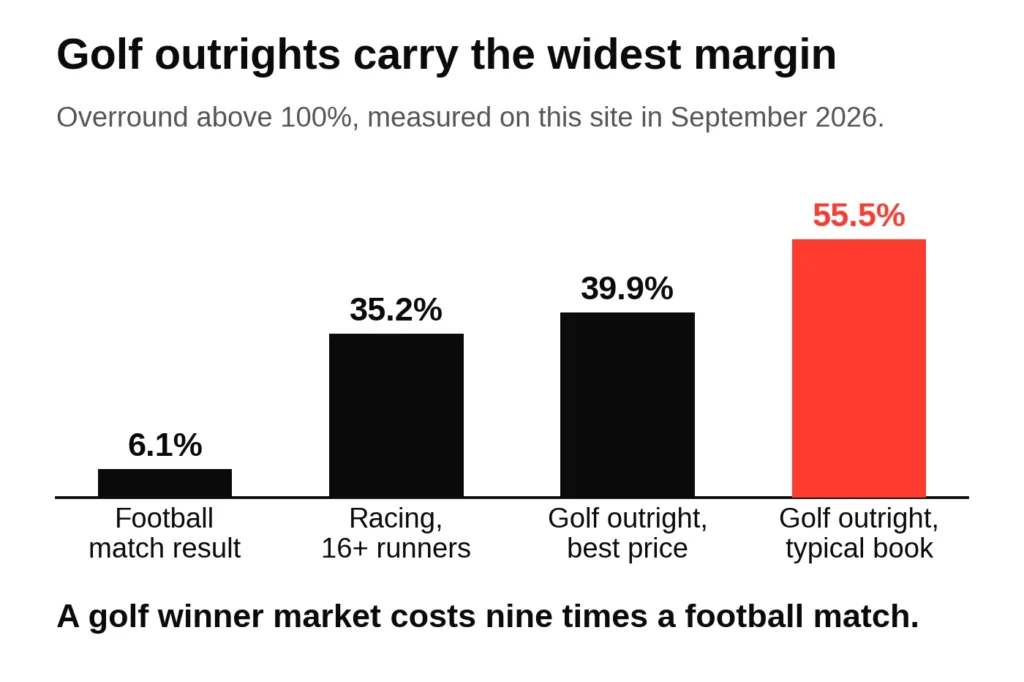
A book has to price every player in a field of 120 or more, and most of them will not win. Each long shot is priced shorter than its real chance, and a fifth of a point shaved off each of a hundred outsiders adds up to half the market. The overround works the same way in every sport; golf simply has the most runners, and the same pattern shows in horse racing, where the margin grows by about 2 points with every horse.
Because every book shades a different set of players, the best price on each player across all books makes a far tighter market than any single book. On the two events we measured, taking the best available price on every player produced a market of 143.4 and 139.9 per cent, 14 to 27 points tighter than the single books.
No other market on this site rewards shopping as much. On a football match result the whole margin averaged about 6 points in our sample, so there is little left to save by shopping; on a golf outright the gap between one book and the best price ran to 14 to 27 points. A punter who backs golf regularly should hold more than one account for that reason alone.
Golf prices sit far further out than in most sports, and at long odds a small step in the fraction is a large step in the return. The implied chance of a fractional price is one divided by the odds plus one, so 10/1 implies 9.1 per cent and 66/1 implies 1.5 per cent.
Between 50/1 and 66/1 the implied chance barely moves, from 2.0 to 1.5 per cent, but the winning return is almost a third bigger. That is why the best price matters so much on a golf outright, and why a point or two of difference between books is worth chasing on every bet.
To check a return before you place it, including the place half of an each way bet and any dead heat reduction, use the bet calculator.
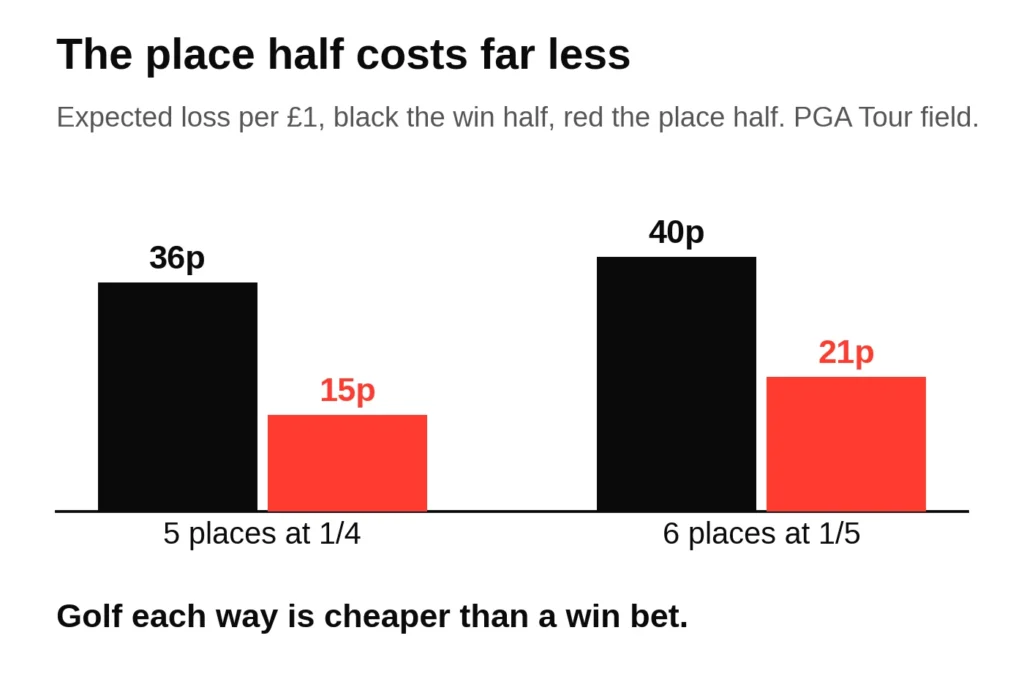
Most golf bets are struck each way, and the numbers show why. On the PGA Tour market, at five places and a quarter of the odds, the win half gave up about 36p for every pound staked. The place half gave up about 15p, because the place terms are generous against the real chance of a top-five finish.
Extra places are not free: the book that paid six places priced the win market 10 to 12 points wider than the books paying five. Read the terms and the win price together, and see how each way betting works for the place arithmetic.
Golf produces ties for places more often than any other sport, and they are settled by dead heat rules: if three players tie for fifth and two of them fall outside five places, the place stake on each is divided by three before it is paid. Withdrawals are settled on whether the player has teed off.
The outright is only the headline. Most golf betting volume sits in markets that settle on finishing positions, rounds or head-to-heads.
The first round leader market settles after 18 holes, so it rewards the things that matter on a single day: an early tee time in calm conditions, a player who starts well at a course, and a draw that puts a strong player in the better half of the weather. Prices are longer than the outright on most players, and ties are common, so dead heat rules cut many winning bets.
Top-finish markets, from top 5 to top 40, are priced as a separate market rather than as the place half of an each way bet. Compare them with the each way place terms before you bet: a top-10 price can be better or worse than the place half of an each way bet paying ten places, and the book does not always price the two the same way.
A 2-ball is a bet on which of two players in the same group scores better in a round; a 3-ball does the same for a group of three. Because only two or three outcomes are priced, the margin is a fraction of the outright’s, and a tie is either a third outcome with its own price or settled by dead heat, depending on the book’s rules.
Round markets are where golf analysis pays: tee times, weather waves and course fit all show up over 18 holes far more clearly than over four rounds.
The four majors carry the deepest golf markets of the year, the most each way extra places and ante-post markets that open months in advance.
The Ryder Cup between Europe and the United States is played in odd-numbered years, and the Presidents Cup, the United States against an International team, in even-numbered years. Both are match play over three days, and the markets behave more like football than like a tournament: a two-way or three-way price on the overall result, with a draw as a real outcome.
Golf is bet in running from the first tee shot to the last putt, with prices that move on every hole and a live leaderboard that settles faster than most broadcasts. Latency and suspensions work as they do in any live market, covered on live betting, and a four-day event gives more time than most sports to find a price the model has not caught up with.
There is no system that beats a 155 per cent market on its own. What separates a good golf bet from a guess is information the price has not fully absorbed.
Golf each way and top-finish markets are where a careful punter can find value against the book, and British-licensed books watch those markets closely. A winning golf account can find its stakes cut on outrights and top-finish markets first. The Gambling Commission data on how bookmakers restrict accounts shows how common and how deep those cuts run.
Books licensed outside Great Britain work to a different commercial model and do not factor stakes in the same way or at the same speed.
The right book depends on the markets you bet.
The one with the tightest outright market, generous each way terms that are not paid for in the win price, clear dead heat rules and a record of keeping winning accounts open. The ranking above is built on those.
Half the stake goes on the player to win and half on a top finish, usually five or more places at a quarter or a fifth of the odds. If the player places without winning, only the place half pays.
Ties for the last place are settled by dead heat: the place stake is divided by the number of players tied for the places that remain.
A bet on which of two players in the same group scores better in a single round. A 3-ball does the same for a group of three.
Because a field of more than a hundred players means even the favourite rarely has more than a one in ten chance, and the book shades every price, which pushes the whole market to 150 per cent or more.
If the player withdraws before teeing off, the bet is void and the stake returned. After teeing off, the bet stands.
No system beats the outright margin on its own. Value comes from information the price has not absorbed, such as course fit, tee times and weather, taken at the best price across books.
Yes. Most books price the outright and round markets live from the first tee shot, repricing after every hole.