
Tools
Bet Calculator for Every Bet Type
A bet calculator turns a set of selections and a stake into the number you actually care about, which is what lands back in your account if they win. This one settles singles, doubles and accumulators, and every multiple from a Trixie up to a Goliath, with each way, void legs and dead heats handled properly.

Work out what any bet returns
Pick the bet type, enter your odds and your stake per line, and the calculator does the rest. Odds go in as decimals, as fractions or as the word evens, and each selection can be marked won, placed, lost or void. Nothing is sent anywhere and nothing is stored.
Bet return calculator
Enter your selections to see what a winning bet pays back. Decimal odds (2.50) or fractional (3/2).
Returns include your stake. An each-way bet is two bets, so the total stake doubles. Void legs are settled at odds of 1.00 and the bet runs on the rest.
What the calculator is telling you
Two numbers come out of any bet calculator and they are easy to confuse. The return is everything that comes back to you, your stake included. The profit is the return minus what you put on. A ten pound single at 3.00 returns thirty pounds and profits twenty, and a bookmaker quoting a return is not being generous, just precise.
The other number worth reading is the line count. A Lucky 15 at two pounds a line is a thirty pound bet, not a two pound one, and the calculator shows the total stake alongside the return for exactly that reason.
Fractional and decimal odds are the same price twice
| Evens, or 1/1 | Decimal 2.00. A ten pound stake returns twenty pounds and profits ten. |
|---|---|
| 6/4 | Decimal 2.50. The fraction is profit to stake, so four pounds staked wins six. |
| 2/1 | Decimal 3.00. Double your stake in profit, triple it in return. |
| 10/11, an odds-on price | Decimal 1.909. You risk eleven to win ten, which is what odds-on means. |
| The conversion | Decimal equals the fraction as a division plus one. 6 divided by 4 is 1.5, plus 1 is 2.50. |
| Why it matters | Decimals multiply cleanly across an accumulator. Fractions do not, which is why every calculator works in decimals underneath. There is more on reading a price in our guide to how betting odds work. |
The bet types the calculator covers
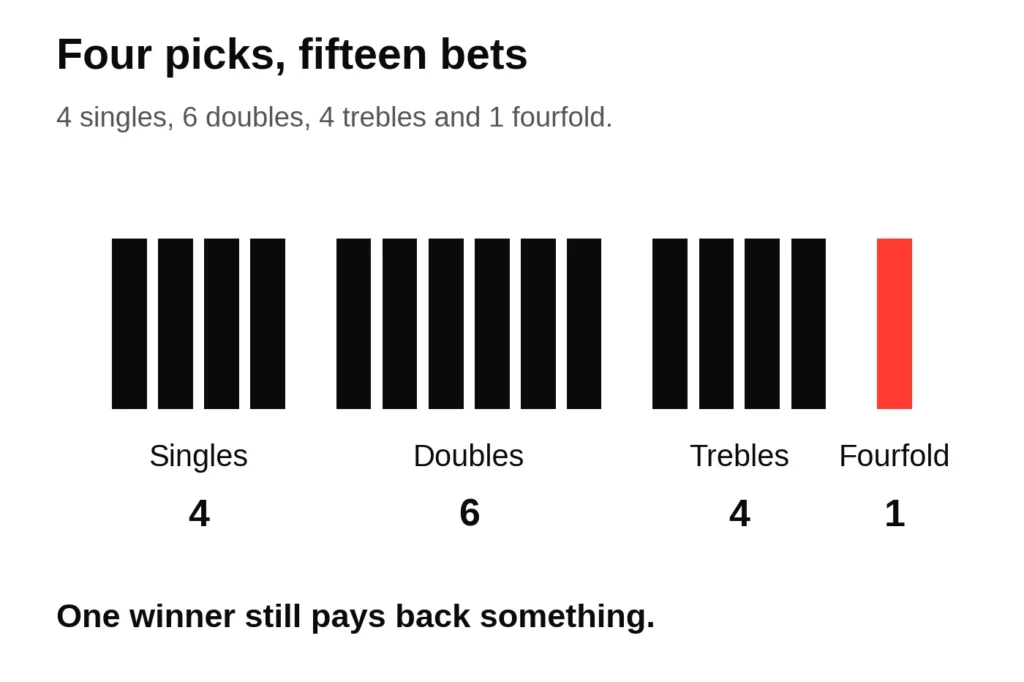
A single is one bet. A Lucky 15 is fifteen. That is the fact that catches people out at the counter, because the stake box asks for a stake per line and quietly multiplies it.
The full and each way distinction matters here too. A multiple placed each way doubles the line count again, so an each way Lucky 15 is thirty bets, not fifteen.

What each multiple is made of
| Double, treble, four-fold and up | One bet. Every selection must win or the bet is gone. |
|---|---|
| Trixie | Three selections, four bets. Three doubles and a treble, no singles. |
| Patent | Three selections, seven bets. A Trixie plus the three singles. |
| Yankee | Four selections, eleven bets. Six doubles, four trebles, one four-fold. |
| Lucky 15 | Four selections, fifteen bets. A Yankee plus the four singles. |
| Canadian, also called a Super Yankee | Five selections, twenty-six bets. No singles. |
| Heinz | Six selections, fifty-seven bets. Everything from doubles to the six-fold. |
| Goliath | Eight selections, two hundred and forty-seven bets. The largest the calculator settles. |
Using it as an acca calculator
The calculator works as an acca calculator too. Choose a 4-fold up to an 8-fold accumulator, enter the odds for every leg and your stake, set each leg to won, lost or void, and it multiplies the prices for you.
- A 10 pound fourfold at 2.00, 1.80, 2.50 and 1.50 multiplies to 13.50 and returns 135 pounds
- If the 2.50 leg is void, it settles at 1.00 and the same bet returns 54 pounds on the other three
- If any leg loses, the whole accumulator loses; a Yankee or Lucky 15 on the same selections pays on the doubles and trebles that still win
- Each way accas are settled as two accumulators, one at the win price and one at the place terms
How to work out Lucky 15 returns
Four selections, fifteen lines. The calculator does this in one click, but the arithmetic is worth seeing once.
-
Convert every price to decimal
A Lucky 15 needs all four prices in the same format before anything multiplies. 2/1 becomes 3.00, 6/4 becomes 2.50, evens becomes 2.00.
-
Settle the four singles
Each winning selection pays its own price on one line of stake. A loser pays nothing and simply drops out of every line it appears in.
-
Settle the six doubles
Every pair of selections, multiplied together. Two winners from four means exactly one of the six doubles lands.
-
Settle the four trebles and the four-fold
Three winners land one treble. All four winners land all fifteen lines, which is the run that makes the bet worth placing.
-
Multiply by the stake per line, not the total
This is the step people get wrong. The return is per line, so a two pound Lucky 15 settles fifteen lines of two pounds against a thirty pound outlay. Bonuses for one winner from four, where a bookmaker offers them, are applied after this and vary by book.
Four winners is the outcome everyone pictures, but the structure is built for a worse day than that. One winner from four still returns something on a Lucky 15, because the four singles are in there, and returns nothing at all on a Yankee. That single difference is what you are paying the extra four lines for.
How to calculate a horse racing bet
Racing brings three rules that change the arithmetic and that most general calculators handle badly. All three are in the calculator above.
An each way bet is two bets of equal stake. Half goes on the win at the full price, half goes on the place at a fraction of it, commonly a fifth or a quarter depending on the race and the field size. A ten pound each way bet costs twenty pounds, which is the most common surprise in racing.

Three racing rules that change what you get back
| Each way | Two bets of equal stake. Half on the win at the full price, half on the place at a fraction of it, commonly a fifth or a quarter. A ten pound each way bet costs twenty pounds. |
|---|---|
| Rule 4 | A deduction from winning returns when a horse is withdrawn too late to re-price the market, scaled to how well backed it was. It comes out of the return, not the stake, so a bet can win and still pay less than the price you took. |
| Dead heat | Two runners tie for a place. The stake on that selection is divided by the number tying, and the reduced stake is paid at the full price. |
| Where the detail lives | Place terms, fractions and field-size thresholds are covered on our guide to each way betting. |
All three are in the calculator above, and all three are reasons a returns figure from a general-purpose calculator can be wrong on a racing bet.

What the calculator cannot tell you
The odds you enter already have the bookmaker margin folded into them. Add up the implied chance of every outcome in a market and a fair book totals one hundred per cent. A real one totals more, and the overshoot is what the book expects to keep whether you win or lose.
That number never appears in a returns calculation, because the calculator takes the price as given. Two bookmakers can hand you two different returns on identical selections and the calculator will faithfully report both. Working out which price was actually worth taking is a separate job, and we cover the arithmetic on our page about the margin built into a price.
What a multiple really costs you
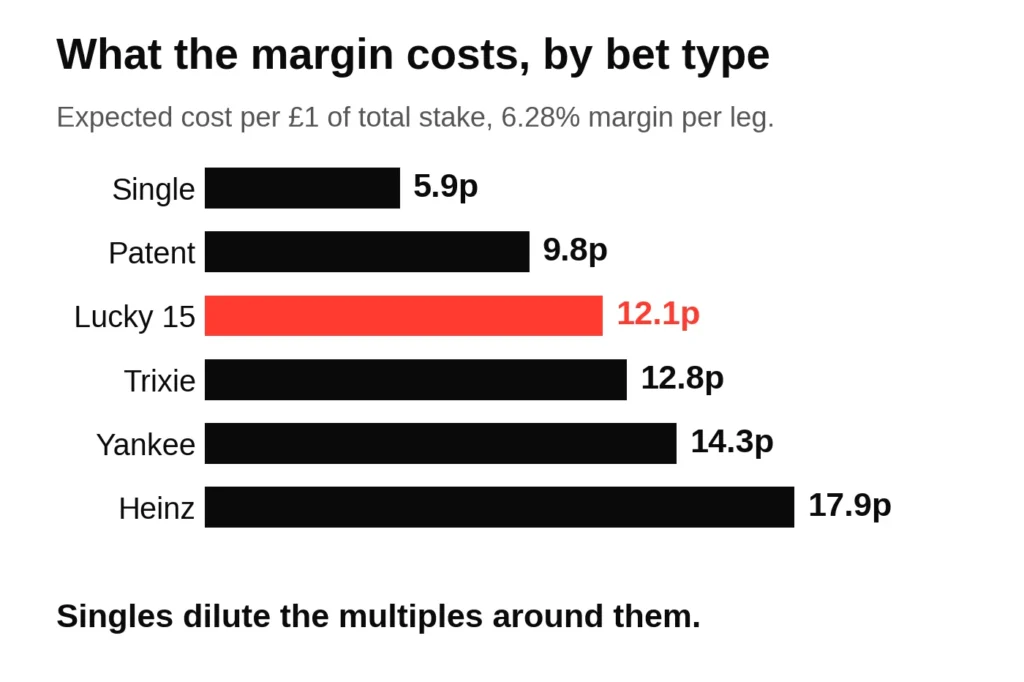
Margin compounds across a multiple, and it compounds differently depending on which multiple you pick. Across fifty Premier League fixtures we measured an average match result margin of 6.28 per cent per selection. Applied to the bet types above, per pound of total stake, the spread is wider than it looks.
Two things that are not obvious at the counter
Both come out of the same table, and both run against how multiples are usually sold.
-
The singles dilute the multiples
A Patent costs less per pound than a Trixie, and a Lucky 15 less than a Yankee, because the singles sit at the cheapest margin available and pull the average down. The extra lines are a discount, not a premium.
-
A Heinz costs three times a single
On the same selections. That does not make multiples a mistake, but it does mean comparing prices on each leg matters more here than anywhere else. The leg-by-leg arithmetic is on our guide to accumulators and multiple bets.
What happens when the calculator is right too often
There is one more thing a calculator will not warn you about. The punters who use one properly, who check a second price before taking the first, are the punters bookmakers identify fastest. The regulator collected the numbers for 2024: of nearly fifteen million active accounts, around 644,000 carried a restriction, and restricted customers were roughly 1.8 times more likely to be in lifetime profit than the average active customer.
Bet calculator questions answered
Convert the odds to decimal, multiply them together for a multiple, then multiply by the stake on that line. The result is the return, stake included. Subtract the stake to get the profit. The calculator above does this for every line in a bet at once.
Fifteen. Four singles, six doubles, four trebles and one four-fold. That is why a two pound Lucky 15 costs thirty pounds, and why one winner from four still returns something when the same selections in a Yankee would pay nothing.
The four singles. A Yankee is eleven bets and needs two winners before it returns anything; a Lucky 15 adds the singles, so one winner still pays. Per pound staked the Lucky 15 is also the cheaper bet in margin terms.
It settles at odds of 1.00 and the rest of the bet stands. A four-fold with one non-runner becomes a treble at the treble price, off your original stake. It does not lose the bet and it does not refund it either.
It splits your stake in two. Half on the win at the full price, half on the place at a fraction of it, usually a fifth or a quarter. A ten pound each way bet costs twenty pounds, and the halves are settled separately then added.
A deduction taken from winning returns when a horse is withdrawn too late for the market to be re-priced. It is scaled to how well backed the withdrawn horse was and it comes out of the return rather than the stake, so a winning bet can pay less than the price you took.
Not automatically, and neither does this one. Consolation offers such as a bonus for one winner from four vary between bookmakers and are applied to the settled return afterwards. The qualifying price is usually higher than people assume.
No, and this is the limit worth understanding. It prices what you were offered. The bookmaker margin is already inside those odds, and measuring it is a different calculation entirely, covered on our page about the margin built into a price.